

The other day while going through the report, I said to my husband, "You know whose name isn't in here as much as you'd think?" Without missing a beat, he says, "John Love."
Youth Pastor and (former?) Chaplain of the New York Knicks

Triggers: sexual abuse, grooming, rape, church hurt, #churchtoo, spiritual abuse, bullying and manipulation. For more context, read this, this, this, this, and/or this. Articles from The Baltimore Banner1 starting here, and the Godly Response to Abuse in the Christian Environment (GRACE) report on Greater Grace World Outreach (GGWO).
When I was a teenager in the early 2000s, attending a GGWO-affiliated church in New England, there was a lot of talk about the Spring Rally and going to hear John Love speak. He was the famed Youth Pastor in Baltimore, and even more exciting for some, the longtime chaplain for the New York Knicks. I don’t remember much about what John Love spoke about at the few teen rallies I attended, but I do recall my overall impression of the man. There was something weird about him.
First, he was wearing leather tassel loafers, dress pants, and a shirt and tie. The incongruous nature of his wardrobe while we were all at a rented summer camp in Pennsylvania made him seem more like an accountant, or the bad guy in an 80s teen comedy, or a school administrator than someone who actually worked directly with teenagers.1 I can see wearing the suit and tie at home in Baltimore, but out in the woods for a fun weekend of camp games and the very weird tradition of boys sneaking out to go to the girls’ cabins2, break out some sneakers and jeans, bud.
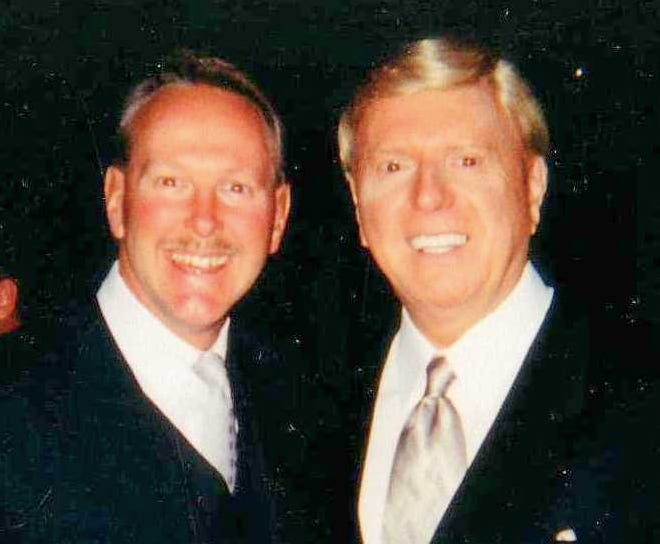
Secondly, during meals, I remember him hanging around the table where he displayed all the merch he’d brought to give away. It had items as pedestrian as New York Knicks-branded CD cases all the way up to still-in-the-box basketballs signed by Paul Pierce and other NBA athletes. He also had a photo album filled with pictures of himself with the various celebrities he’d met during games at Madison Square Garden. He’d happily stand there, leafing through the photos with you while dropping in commentary on how down-to-earth the famous people were.

It felt like the sports merch and autographs were designed to impress the boys, and the photos and descriptions of celebrities were to impress the girls. For me, both were weirdly alienating. I was not a kid who cared about sports, and hearing him talk about how nice Sarah Michelle Gellar3 was felt weird.4 A bit like he was trying too hard to ingratiate himself with us. So when Love is quoted in the GRACE report in such a way that sounds like he’s trying real hard to make himself come across as ‘not so bad,’ it’s not so surprising.
Jesse Anderson, one of the two men brought up on charges and convicted of sexual abuse in the early 2000s, was accused of inappropriate behavior by multiple boys in his charge as a volunteer summer camp counselor — this is prior to the incident he was tried for. The boys told their parents, who went to John Love; he and his then-supervisor, Dr. Daniel Lewis, met with Anderson to discuss the accusations. According to John Love, Lewis was going for a slap on the wrist, but he intervened.
“Dr. Lewis spoke with him, and at the end of the conversation, he basically said, “Do you promise that you won’t do this again?” And that’s when I said, “Wait a minute, he’s never going to do it again, because he’s never coming to camp. He’s never coming back to camp. He’ll never be a counselor again.”5 And to be honest with you, Dr. Lewis at the time was a little shocked by what I said, but I’m not going to take that chance,” (GRACE report, page 16).
So while Love banned Anderson from volunteering at the summer camp, he apparently did nothing to prevent the young man from volunteering to work with children in other areas, including the Sunday School, where Anderson came in contact with the boy he is convicted of assaulting. To his credit, Love acknowledges this faux pas to GRACE, “[Anderson] should have been removed completely from having anything to do with working with young people,” (page 17). As much as I want to believe Love is being sincere, for some reason, it’s difficult to take him at face value. I don’t know if I’m struggling with that because of Love’s attitude, or if it’s because of his colleagues’ obvious insincerity.6 But there’s a little bit of a shamefaced, falsely contrite air about Love’s concession.

On page 89, a witness recalls an incident during a youth rally where she witnessed John Love giving driving lessons to kids possibly as young as thirteen. Rightly uncomfortable, the staff member went to Love with her concerns,
“I made my opinion very clear to him and to Pastor Pete later on when I saw him that day. Like, ‘What, what are we doing? They don’t have their permit. You don’t have their parents’ permission. It’s straight up illegal, unlicensed drivers,” (footnote 566).
According to the witness, Love blew off her concerns. However, when another pastor, Peter Taggart — who I assume is ‘Pastor Pete’ — asked him about it later, Love conceded, “we’ll not be doing that anymore,” (page 89). The only difference between the two people voicing concerns about minors driving his car is that one was a female volunteer, and the other was a male pastor. I’m speculating here, but I don’t think it’s too far afield to assume that Love felt like he could dismiss the witness’s concerns because she was a woman7, but felt like he had to capitulate with the male pastor, to, I don’t know, save face?
John Love is no saint, no matter how much he might want everyone to believe he did his best to do everything above board and stopped immediately when he realized he was in the wrong. There are reports of him using what might be otherwise considered ‘privileged information’ to shame and bully literal children from his pulpit. Assuming the teen group in Baltimore ran similarly to the one I attended in New England, the youth pastor would give a 20-30 minute Sunday morning lecture-style sermon, then we’d play games and socialize for the next half hour. In the report, one woman shares the time Love called her out during a youth service.
A week earlier, she’d gone to Love for counsel. She’d been raped at a party. Not knowing this, Love told her he didn’t have time, but assigned two men who worked with him to talk with her. At the youth service, she recalled Love speaking about the dangers of being outside of what GGWO calls the “geographical will of God”8 and was shocked to hear herself being referenced.
“There was a young woman who left the will of God, and she went out to a party, and there was alcohol, and there was drinking, and she had sex. And this young woman brought shame on herself, and she chose the world, and she brought God’s judgment on herself, and she’s infected, and she’s to be avoided. And she’s here. She’s here tonight,” (page 105).
While he didn’t use her name, the witness claims there were way too many details from her own story in Love’s recounting for it not to have been about her. Apart from demonstrating a clear lack of understanding when it comes to victims of sex crimes, Love here also demonstrates a lack of understanding of basic human compassion, the kind Jesus demonstrated in his ministry.
Famously, in the New Testament, a woman with some sort of blood disorder risked going into town, joined a crowd of people, and touched Jesus’s cloak, and she was healed. There were rules in that society which can be found in what Judaism calls the Torah, and many Christians call the Pentateuch: the first five books of the Christian Bible. Three of those books detail the rules for the new Israelite society post-Egypt, often referred to as The Law. Included are rules about women who are bleeding (Leviticus 15:19-30). They are considered unclean, as would be anything they touched or sat upon, and anyone who touched them would also be unclean, as would anything they touched or sat upon. So, for a woman with a bleeding disorder to come into town and deliberately touch other people, it was a big deal. But when she touched him, Jesus did not reprimand her or tell everyone to move away from the woman, or to shame and ostracize her. In the account of this story in Matthew, Jesus simply says to her, “Take heart, daughter; your faith has made you well,” (Matthew 9:22, NRSVue). In Luke and Mark, the woman volunteers the reason why she touched him, and Jesus’s reply is much the same as in Matthew (Mark 5:24-34; Luke 8:43-48). He shows compassion and love for the woman and welcomes her back into regular society. John Love, however, happily stood before a group of people and told them to stay away from a girl who’d been, in her words, “hurt by a boy,” (footnote 650, page 105), blaming her for being at the party in the first place, implying that the rape was her punishment.
This bullying behavior is not unique to Love, but appears to be a part of the culture — a topic I plan to discuss in another post. Recently, I have been listening to episodes of the now-ended Children of Grace podcast9 — a fantastic deep dive into the early days of The Bible Speaks10 in Maine and the Berkshires — in which I learned of founder Carl Stevens’s tendency to claim that anyone who spoke poorly of the church would develop throat or tongue cancer and die. Stevens’s tactics, as are Love’s, are all about control. As the same witness who went to the party put it, “It was a very effective way of keeping us teens in line…. It was an intentional psychological control and fear that John would instill in the youth group and so many different kids,” (footnote 568, page 89). She says he even sometimes would actually name names when he “[took] a youth’s confidential personal material and [used] it as a sermon illustration in front of that youth,” (page 89); unlike in her case, where he simply gave enough details that she knew he was talking about her.
Another time, he berated the school children for not bringing their Bibles to chapel. Even going so far as to kick out anyone who didn’t have one, then “preached a sermon comparing them to people who “fall by the wayside” and stop following Jesus,” (page 89). And there’s another story of Love reprimanding a girl for “flipping upside down on the swings while wearing skirts with shorts underneath,” (page 89). John Love is said to have made comments about the middle school student, “something along the lines of [she] would never make it to marriage if [she] was already acting so promiscuous,” (page 89-90). Leaving the girl feeling very confused and filled with undeserved11 shame. John Love has been the youth pastor since at least the 1990s; I can’t help but feel that there are way more stories like these out there.
Not that long ago, John Love applied for an open Senior Pastor position at the affiliate church I used to attend. I remember telling my father that I really hoped the hiring committee didn’t choose him. My reasons had to do with his age. There were enough white men over the age of fifty on the board of Elders, and the other serious candidate was a young guy, early thirties, potentially a different outlook from the old men. I’m now even more glad the committee went with the young guy. That kid’s not without his problem areas, but as of this writing, his issues don’t go the way of berating children, public shaming, or bullying.

There’s a reason John Love is named as one of the leadership that ought to be removed from his position of influence — along with Tom Schaller, Steve Scibelli, and Pete Westera. His sycophantic nature12, his reckless behavior with young teens, openly bullying and shaming teenagers like he’s the fucking Shame Wizard from Big Mouth, make him unfit for pastoral work. He’s not shepherding the youth; he’s terrifying them into obedience.
In my twenties, I worked in outdoor education and met many school principals who came on, or for part of, the field trip, and none of them wore their work attire while at the camp.
Apparently, this was a bit of a thing, possibly a tradition? So common that it warranted an adult whose sole purpose that weekend was to not sleep and patrol the woods around the cabins to make sure boys didn’t make it to the girls’ cabins. Which, in light of everything in the GRACE report, now raises the question as to whether or not there were boys skulking around, or was it just this adult man roaming around the cabins all night? Was he alone? Did he have a team working with him? If you remember any details, please let me know.
Especially when you take into account that SMG’s biggest roles were TV shows and movies that “good Christian parents” were not likely to let their kids watch. Buffy? With Vampires and portals into hell? I mean, I suppose she was killing the demons, so there’s a sermon illustration right there, but Buffy falls in love with two separate vampires, and her best friend is a lesbian witch!
I’m generally not super excited about meeting celebrities. On the one hand, they’re just people, and on the other, they’re people I don’t know, and I already have social anxiety and get super shy around people I don’t know. A friend once surprised me with a photo-op with Jewel Staite at Boston ComiCon while I was dressed as Kaylee from Firefly, and I did not know how to act or what to say when we met her. Luckily/annoyingly, we were rushed through the line, and I didn’t have time to make a complete ass of myself.
Bold emphasis mine.
I’m referring specifically to senior pastor Tom Schaller and director of missions Steve Scibelli. And indirectly, Carl Stevens, from whom there is much evidence of telling falsehoods to get what he wanted, both successfully and unsuccessfully.
Which is a whole other thing I’ve got opinions about. Another time, though.
This is one of Carl Stevens’s insane, made-up terms. According to the report, it’s defined in the GGWO Glossary, “This refers to the exact location for the believer in the plan of God; it also includes the right local assembly under the right pastor-teacher for the believers, so they can learn about God’s nature and character through His Word,” (page 102). It appears to mean being in the church where God has called a person, but Love seems to be using it to mean being in physical locations deemed permissible by God, like life is a giant game of tag with designated ‘safe spaces’ — nu-uh, devil, I’m on base!
Such a fantastic podcast, so well researched, and includes first-hand accounts of what the church was like in the 70s, 80s, and 90s. I am still working my way through it, learning new things that put what I experienced and things happening today into perspective. You should listen to it, and check out the newly launched Looking for Grace podcast while you’re at it.
GGWO’s former name in the 70s and 80s.
My assessment.
This will likely be discussed in a future post.